Working template
FounderVibe Operating Loop
Design one marketing workflow your team can trust.
Use these ten questions to connect context, AI work, checks, human judgment, and a useful outcome.
10design questions
Realexamples
Namedapproval
30day review
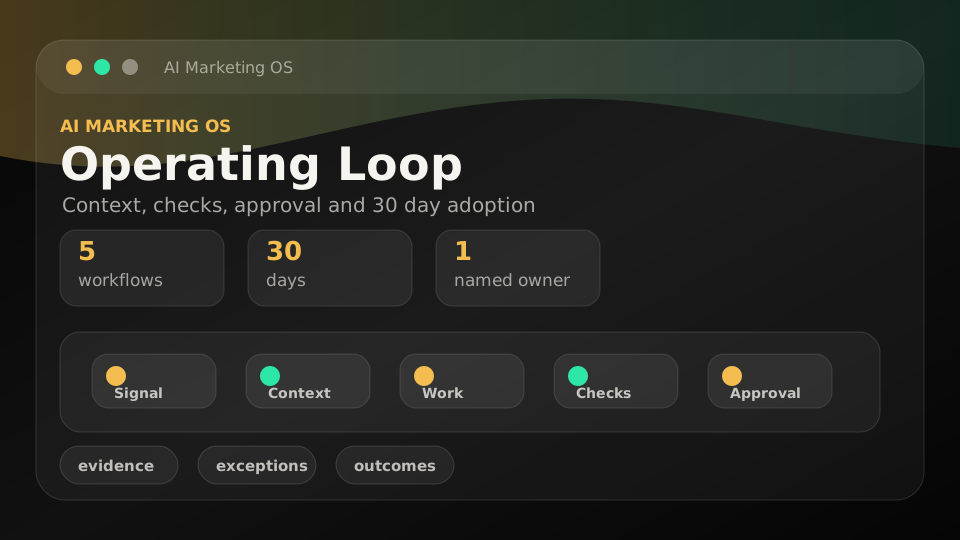
Operating loop
Every workflow has a visible path from signal to outcome.
The tool can change. The operating logic stays inspectable, owned, and useful to the next decision.
The workflow reads approved business and brand files.
AI prepares a bounded output at a defined destination.
Facts and quality are tested against explicit criteria.
A named person makes the decision that matters.
The result and next decision return to the system.
Worksheet
Answer these before choosing more tools.
A useful answer is concrete enough that another person can run the workflow and explain what happens when a source is missing, a check fails, or approval is late.
- What real signal starts the work?
- Which approved context does the workflow need?
- Who owns the workflow?
- What may AI prepare or recommend?
- Where does the result go?
- Which facts must be checked?
- Which qualities require judgment?
- Who approves the result?
- Which outcome shows that the work was useful?
- What result or correction changes the next run?
Reliability
Quality is part of the workflow.
Good output is defined before volume increases. Real failures and corrections improve the same system.
Evidence before confidence
Material claims need a source. Unknown information stays marked as unverified.
Human judgment stays visible
Publishing, customer contact, positioning, pricing, and sensitive decisions require a named approval.
Exceptions over activity
The system surfaces failed runs, broken connections, weak output, and waiting decisions instead of rewarding volume.
Proof
Measure use and outcomes, not output volume.
The baseline is agreed before installation. The 30 day review shows what the team used, where the loop failed, what improved, and what should change next.
Success measures
- Operator adoption and supervised run rate
- Time from trigger to approved output
- Failed runs, exceptions, and correction rate
- The business outcome attached to the workflow
Operating boundaries
- No autonomous publishing or outreach by default
- No unsupported performance or revenue promise
- No permanent custody of client credentials
- No enterprise integration or custom software inside the fixed packages
First pilot
Start with one loop people will actually use.
Bring five real examples, one named operator, one approval owner, and one observable outcome. FounderVibe designs, installs, tests, and hands over the loop.
EUR 499
- One operating loop
- Real test cases
- Fact and quality checks
- Runbook and approval rule
- Operator session